
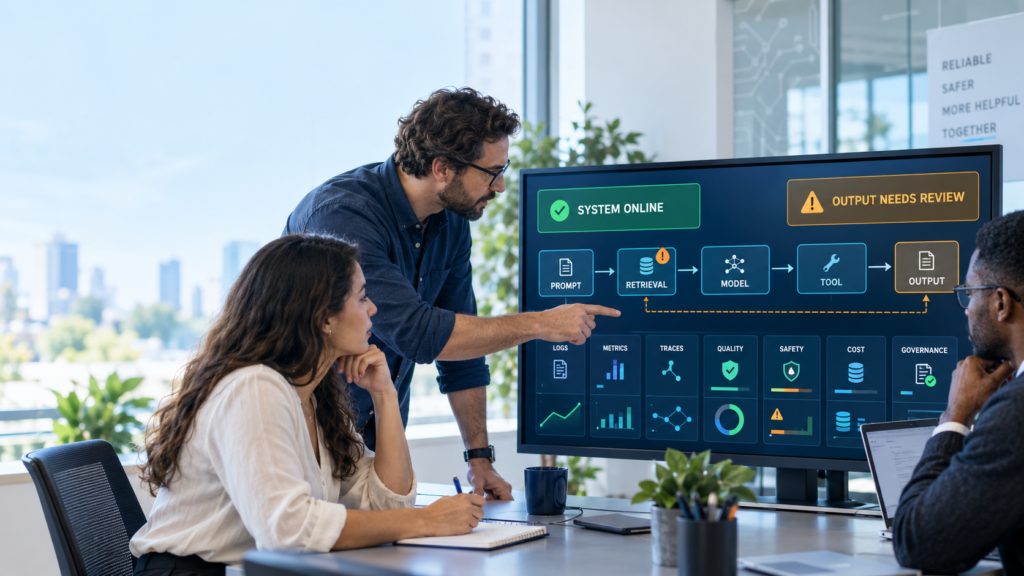
AI observability is the practice of collecting and analyzing telemetry — logs, metrics, traces, and quality evaluations — from an AI system so that teams can tell not just whether it is running, but whether its outputs are correct, grounded, safe, and cost-efficient. In plain terms: can you tell why your AI gave a specific answer, and can you trust that it’s the right one?
It extends a decades-old idea from software engineering — observability, the ability to infer a system’s internal state from the data it produces — into a world where the “state” of an AI system includes the accuracy and trustworthiness of what it generates, not just whether it stayed online.
Demand for AI observability has grown sharply alongside enterprise adoption of large language models and autonomous AI agents. Market researcher SNS Insider values the global AI observability market at roughly $2.71 billion in 2025, projecting growth to $20.52 billion by 2035 — a 22.47% compound annual growth rate — with cloud-based deployment and large enterprises currently leading adoption, and small enterprises now the fastest-growing customer segment.[9] Standards bodies are moving in parallel: OpenTelemetry’s GenAI working group is actively finalizing shared conventions for how AI agents report telemetry.[5]
What Is AI Observability?
Traditional software either runs or it doesn’t, and it fails in fairly predictable ways: a server times out, a request throws an error. AI systems fail differently. A large language model can return a fluent, confident, and completely wrong answer while every conventional health check shows green — no errors, no downtime, no triggered alert.[8] As Datadog puts it, AI observability exists to answer “not just whether a system is running, but whether its outputs are correct, grounded, safe, and useful.”[6]
In practice, that means instrumenting the whole path a request takes — the prompt, any documents retrieved to ground the answer, the model call itself, and any external tools the system used — as one connected record, so a specific bad answer can be traced back to its actual cause instead of guessed at.
Why Does AI Observability Matter?
The risk isn’t hypothetical. Microsoft’s security research team describes a scenario in which an AI email agent receiving poisoned content from another agent could be tricked into forwarding sensitive documents to an attacker — while “traditional health metrics stay green: no failures, no errors, no alerts.”[8] An empirical study of machine learning practitioners similarly found that production ML systems “fail silently — not with crashes, but through wrong decisions,” and identified real gaps in what teams currently capture to catch this.[3]
Beyond catching failures, observability delivers measurable operational value: lower cost through reduced token usage and retry rates, faster incident response — including the ability to roll back a bad model update in real time — and audit-ready evidence for governance and compliance teams.[8]
Key Components of AI Observability
Conventional observability rests on three pillars: logs, metrics, and traces. AI systems layer two more elements on top. Quality telemetry scores whether an output is actually correct — grounding scores and hallucination detection, not just whether a response was delivered. Security telemetry watches for prompt-injection patterns and data-leak signals unique to how AI models process untrusted input.[6] Two further practices tie it together: continuous evaluation of response quality, and governance that turns the same telemetry into audit-ready compliance evidence.[8]
How Is AI Observability Different From MLOps and AIOps?
The terms overlap but aren’t interchangeable. MLOps standardizes the development, deployment, and lifecycle management of machine learning models — the pipeline itself. A 2025 systematic literature review of 45 peer-reviewed studies found that “continuous monitoring and feedback loops” are one of the core best practices that separate mature MLOps programs from immature ones.[2] AIOps uses AI to automate IT operations tasks like patching and incident triage, and functions as a subset of broader IT operations. Observability sits underneath both: it’s the underlying capability of being able to know a system’s state from the data it emits — the raw material that both MLOps and AIOps depend on to function.[7]
Where Is AI Observability Applied? LLMs, RAG, and AI Agents
Agentic AI adds an extra layer of risk, because an agent chains together reasoning, tool calls, and multi-step planning — any link of which can fail quietly. The field is actively standardizing around this: OpenTelemetry’s GenAI Special Interest Group has finalized conventions for how individual AI agents report telemetry, based on Google’s AI agent architecture, and is separately developing shared conventions across agent frameworks such as LangGraph, CrewAI, and AutoGen.[5] For retrieval-augmented generation (RAG) systems specifically, observability needs to trace a wrong answer back through the retrieval chain — was it a bad prompt, a stale knowledge source, or a retrieval miss — rather than simply flagging that the output was wrong.
What Are the Challenges of AI Observability?
The most consistently cited obstacle is scale: manual monitoring becomes unworkable given the data volume, architectural complexity, and need for real-time tracking that production AI systems demand.[4] Layered on top of that is the non-deterministic nature of AI itself — the same input can produce a different output each time it runs — plus the difficulty of defining “correct” for open-ended generated text, and the organizational challenge of getting AI/ML, DevOps, product, and security teams to actually share and act on the same telemetry.[3] One peer-reviewed study addressing a related problem — detecting when a deployed model has drifted from its training data without labeled examples to check against — used explainability techniques (SHAP values) to flag drift with better than 90% detection accuracy in cybersecurity applications, illustrating both how solvable these problems are and how specialized the tooling still needs to be.[1]
Key Takeaways
- AI observability measures whether AI outputs are correct, grounded, safe, and cost-efficient — not just whether the system is technically running, since AI systems can look perfectly healthy while quietly producing wrong answers.
- It differs from monitoring (which watches for failure patterns you’ve already anticipated) and from MLOps and AIOps (which manage model lifecycles and IT automation) — observability is the underlying data layer all three depend on.
- A complete implementation combines logs, metrics, and traces with AI-specific quality telemetry, security telemetry, evaluation, and governance.
- Agent and RAG observability is being actively standardized industry-wide through OpenTelemetry’s GenAI semantic conventions.
- The global AI observability market is projected to grow from about $2.71 billion in 2025 to $20.52 billion by 2035, a 22.47% annual growth rate — with adoption now accelerating fastest among smaller enterprises.
Frequently Asked Questions
Is AI observability only relevant for large language models?
No. It applies to any AI system in production, including traditional machine learning models, computer vision, and recommendation engines. Large language models and autonomous agents have driven most recent tooling innovation because their non-deterministic, multi-step behavior is harder to catch with conventional monitoring methods.
If I already use application performance monitoring, do I still need AI observability?
Generally, yes. Application performance monitoring tracks infrastructure health — latency, uptime, error rates — but it cannot tell you whether an AI system’s output is factually correct or grounded in real data. AI observability adds a quality and safety layer that conventional monitoring was never designed to provide.
What’s the difference between AI observability and explainability?
Explainability is about understanding why a model made one specific decision, often for a single prediction. Observability is the broader, ongoing practice of collecting and correlating data across an entire AI application so problems can be detected, diagnosed, and investigated continuously as they emerge in production.
Does AI observability help with AI regulatory compliance?
Yes. Frameworks such as the U.S. NIST AI Risk Management Framework encourage organizations to build trustworthiness considerations into AI systems throughout their lifecycle, and observability instrumentation is what generates the auditable evidence — of what a system did, when, and why — that this kind of governance requires.
References and Further Reading
- Lee, Y., Lee, Y., Lee, E., & Lee, T. (2023). “Explainable Artificial Intelligence-Based Model Drift Detection Applicable to Unsupervised Environments.” Computers, Materials & Continua, 76(2), 1701–1719. https://doi.org/10.32604/cmc.2023.040235 (peer-reviewed journal)
- Zarour, M., Alzabut, H., & Al-Sarayreh, K. T. (2025). “MLOps best practices, challenges and maturity models: A systematic literature review.” Information and Software Technology, 183, 107733. https://doi.org/10.1016/j.infsof.2025.107733 (peer-reviewed journal)
- Leest, J., Gerostathopoulos, I., Lago, P., & Raibulet, C. (2025). “Monitoring and Observability of Machine Learning Systems: Current Practices and Gaps.” arXiv:2510.24142 (preprint, Vrije Universiteit Amsterdam & Università degli Studi di Milano-Bicocca). https://arxiv.org/abs/2510.24142
- IBM. “What is LLM Observability?” https://www.ibm.com/think/topics/llm-observability
- OpenTelemetry. “AI Agent Observability – Evolving Standards and Best Practices.” https://opentelemetry.io/blog/2025/ai-agent-observability/ (standards body)
- Datadog. “What Is AI Observability?” https://www.datadoghq.com/knowledge-center/ai-observability/
- BMC Software. “AIOps vs. MLOps vs DevOps vs. ITOps vs. Observability: What’s the Difference?” https://www.bmc.com/blogs/aiops-vs-mlops-devops-itops-observability/
- Microsoft Security Blog. (2026). “Observability for AI Systems: Strengthening visibility for proactive risk detection.” https://www.microsoft.com/en-us/security/blog/2026/03/18/observability-ai-systems-strengthening-visibility-proactive-risk-detection/
- SNS Insider. (2026). “AI Observability Market Projected to Hit $20.52 Billion by 2035.” Market report via GlobeNewswire (industry market data)
- National Institute of Standards and Technology (NIST). “AI Risk Management Framework.” https://www.nist.gov/itl/ai-risk-management-framework (U.S. government)